Developed in 1995 and officially released in 1996, PRINCE2® has gone on to become one of the world’s most recognised project management frameworks. The story is particularly special to us at PM Academy.
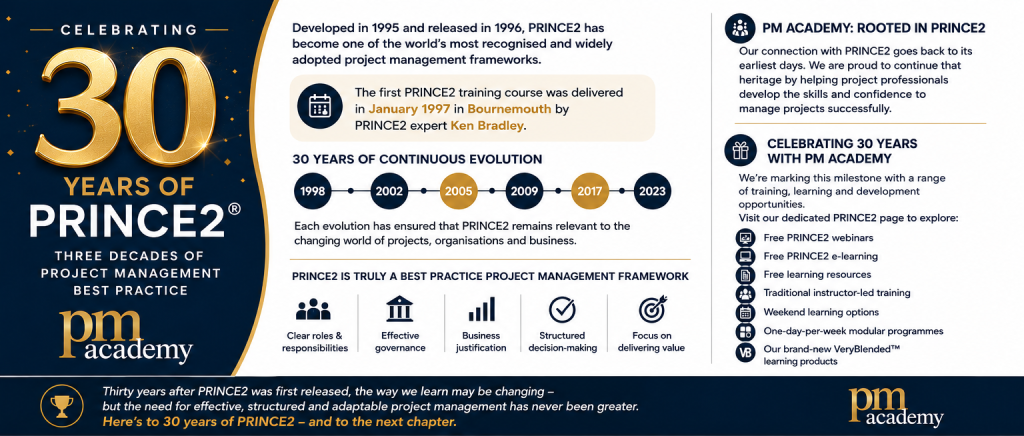
The first PRINCE2® project management training course was delivered in January 1997 in Bournemouth, UK with just 4 delegates in attendance. From those pioneering early days, PRINCE2® has grown into a globally recognised best-practice framework, supporting project professionals and organisations across sectors, industries and countries.
30 years of continuous evolution
A great strength of PRINCE2® is it’s ability to evolve. The method has been updated and refined over the years, with significant developments in 1998, 2000, 2002, 2005, 2009, 2017 and 2023.

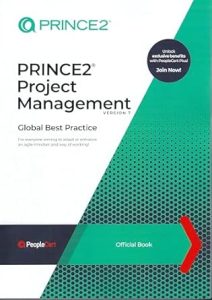
Each evolution has helped ensure that PRINCE2® remains relevant to the changing world of projects, organisations and business.
1996-2009
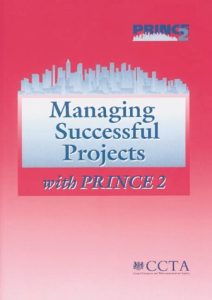
The first edition of PRINCE2® was released in October 1996 as a ring binder. Owned by the Central Computer and Telecommunications Agency (CCTA), the ring binder proved very useful in that the pages laid flat when referencing the Processes or Components (now called Practices). Within 18 months the format changed to perfect bound copies due to its success. Ring binders were proving to be costly and more difficult to ship.
The 1998, 2002 and 2005 editions were managed under the Office of Government Commerce. The structure of these earlier editions were 8 Processes, 8 Components and 4 Techniques. These have remained largely the same over the years, with the following techniques now being integrated into the Components (Practices).
- Product-based Planning
- Change Control approach
- Quality Review technique
- Project filing techniques
The earlier editions also included some great appendices including Roles and Responsibilities and a Project Health Check. All editions from 1998, 2002 and 2005 included 5 or 6 PRINCE2® Principles which were buried in the first introductory chapter. These early editions also included what was affectionately termed “PRINCE2® coding”, giving PRINCE2 Practitioners a language of their own! For anyone who learnt PRINCE2® pre-2009, you’ll know what I’m talking about. Here are some of my personal favorites…
- SU4 – Preparing a Project Brief
- IP2 – Planning a Project
- DP4 – Giving ad hoc direction
- CS1 – Authorising Work Package
- CS3 – Capturing Project Issues
- CS5 – Reviewing Stage Status
- MP2 – Executing a Work Package
- SB5 – Reporting Stage End
- CP2 – Identifying Follow-on Actions
2009 – 2017
A major update released in 2009 by the Cabinet Office saw the Principles brought to the forefront. The 2009 edition reduced the Processes from eight to seven, with the Planning process being integrated into the Plans Component. The Components were renamed to Themes and reduced from eight to seven, with Configuration Management moving into a new Change Theme. The Principles were increased to seven and promoted as the key to ensuring integrity of the method. This gave us the 7, 7, 7 structure that we still have now.
The edition was enhanced by Axelos in 2017 and continued with a strong focus given to tailoring to ensure the use of PRINCE2® is appropriate to the project. This has always been the key to successful project management using PRINCE2® and is embedded into the guidance in every chapter.
2023 – 2026
The latest update by PeopleCert introduced a new People chapter which emphasises the importance of leading successful change and leading successful teams. With 90% of the project manager’s time spent on communication, this new integrated element is key in today’s world of AI and technological advancements.
Today, PRINCE2® continues to provide a practical and adaptable framework built around clear roles and responsibilities, effective governance, business justification, structured decision-making and a focus on delivering value.
That is why, after 30 years, PRINCE2® remains a genuine best-practice project management framework.
PRINCE2®is a registered trademark of PeopleCert.
About PM Academy
PM Academy is a PeopleCert Accredited Training Organization (ATO), delivering certificated training in project, programme, portfolio, agile and change management.
We work with individuals, teams, and organisations to develop practical skills, recognised qualifications, and real-world capability, providing training solutions that work for you. Our delivery methods include:
- Classroom (Face to face and Virtual)
- We can come to you and train your team, or deliver public scheduled courses or closed courses on MS Teams, Zoom, or a platform of your choosing.
- e-Learning and v-Learning
- Ranging from pure self-study with support if needed, to full virtual learning that combines e-learning with live online training sessions
- FlexPath
- A learning programme that sees traditional intense 4 and 5 day courses delivered over a 4-5 week timeframe. These courses present the training as 1-day per week, over consecutive weeks. Perfect if you can’t commit to a week out of the office.
- Weekend
- Two weekends to deliver the course content. A great solution for those who simply do not have time in the working week, or for self=-employed who cannot afford to lose a week’s pay.
All our training comes with full support from accredited trainers and is available during the crucial pre-course preparation, during the training course, plus post course for when you need that extra help putting the training into practice.
Exams can be provided online at your preferred date and time, or as traditional paper-based exams for closed client courses.